
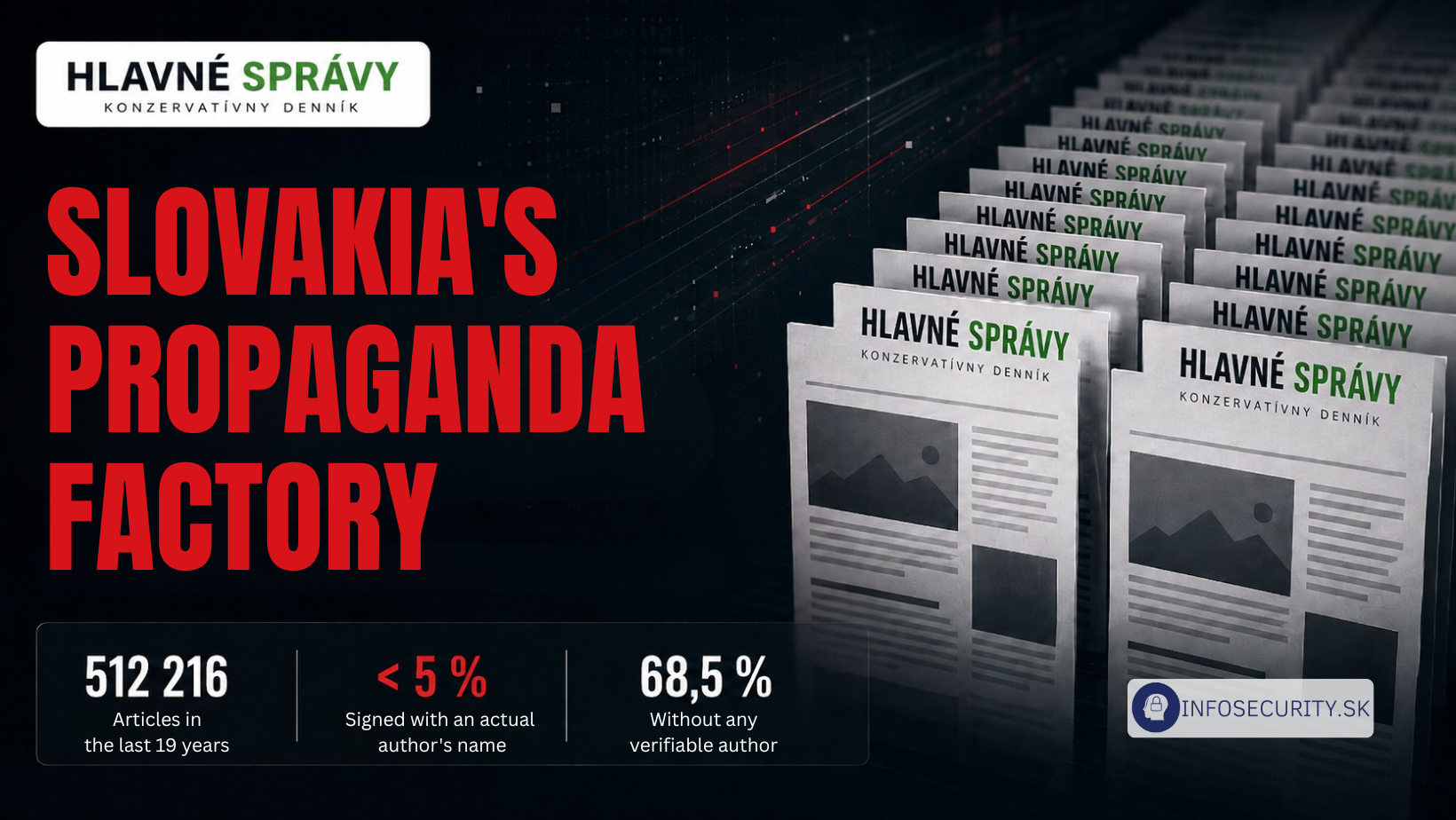
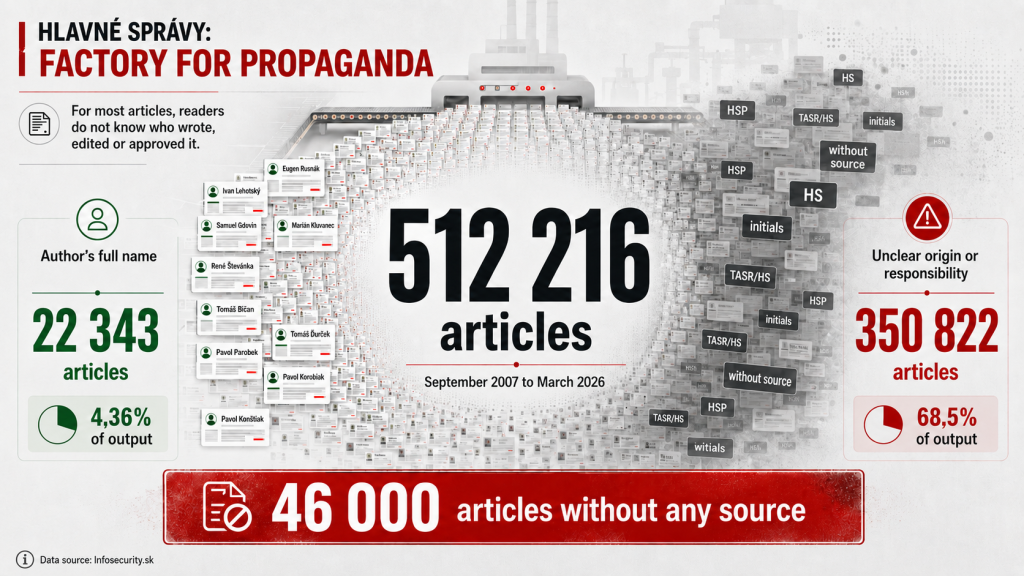
We downloaded 512,216 articles published by Hlavné správy between September 2007 and March 2026. In most of them, readers cannot reliably tell who wrote the article, who edited it, or who approved its final form.
Over almost nineteen years, fewer than five per cent of articles carried an author’s first name and surname. The most prolific byline on the website belonged to a Russian “journalist” who, with the portal’s knowledge, wrote under a cover name.
Another 280,000 articles looked like news agency copy, but also carried the Hlavné správy label. Róbert Sopko, the operator of the disinformation website, himself admits that the newsroom supplemented, combined and changed the headlines of republished agency reports. Readers therefore cannot see where the agency report ends and where the intervention of an anonymous editor begins.
That is how a propaganda factory works. Not only by publishing lies and half-truths, but by building a system in which readers are denied the most basic information about where the content came from, who changed it and who is responsible for it.
Among the key findings:
- How a Russian journalist became the most frequently credited author in the history of Hlavné správy;
- Why Hlavné správy hid his real identity from readers;
- What the man behind almost 3,500 articles on the website actually wrote about;
- How news agency labels helped conceal anonymous editorial interventions in hundreds of thousands of articles;
- How content from Sputnik and other Russian sources also appeared under the Hlavné správy label;
- Why the case shows that the real problem with Hlavné správy is not only individual articles, but the editorial system itself: a system in which outside sources, anonymous interventions and the portal’s own responsibility disappear behind the website’s label or borrow the credibility of established news agencies.
The most prolific byline belonged to a man who did not exist
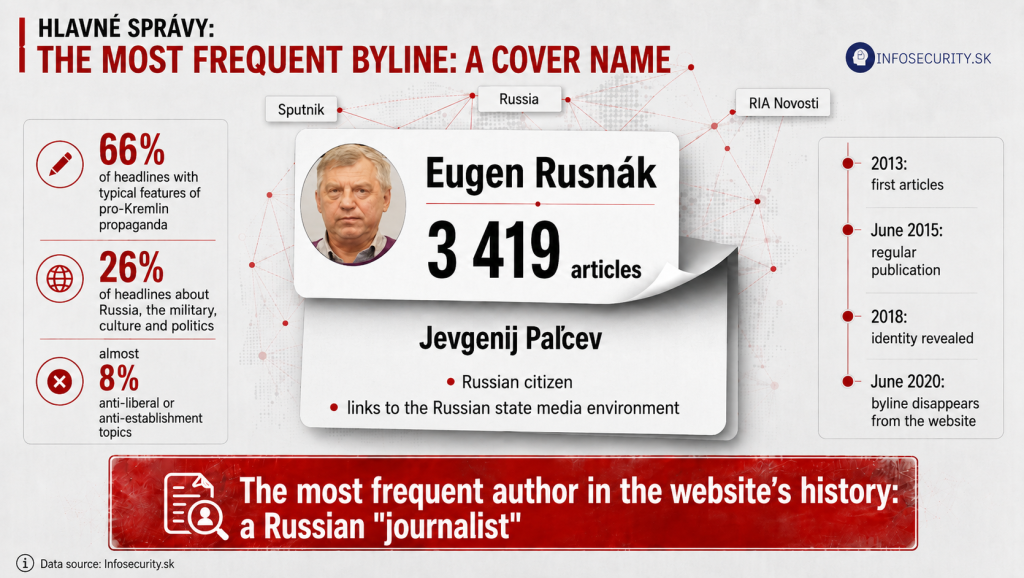
On Hlavné správy (HS), the highest number of articles, 3,419, appeared under the name Eugen Rusnák. But that was not the author’s real name. As Denník N previously established, the name concealed the Russian citizen Yevgeny Paltsev, who was linked to the Russian state media group Rossiya Segodnya, which includes Sputnik, one of the Kremlin’s best-known propaganda outlets, and RIA Novosti. What was not known until now is that this was the single most frequent byline in the almost nineteen-year history of Hlavné správy.
In a response to Infosecurity.sk, the owner of Hlavné správy, Róbert Sopko, said Eugen Rusnák “is not a false identity, but a pseudonym of Eugen Paltsev”, and that Hlavné správy had an author’s contract with him and paid him fees. That makes the portal’s editorial responsibility for the published content harder to dispute: this was not a casual outside contributor, but a known, paid collaborator.
The most important part, however, is Sopko’s explanation. According to him, Paltsev used the “pseudonym” so that other media would not know he was writing for Hlavné správy. On the operator’s own account, Hlavné správy knowingly concealed the identity of a Russian citizen and journalist linked to Russian state media, who was writing for the portal for a fee.
Paltsev’s articles appeared on Hlavné správy as early as 2013, but began to be published regularly from June 2015. From that point, they appeared almost continuously, seven days a week. In the record year of 2019, there were 784 of them, more than two a day on average. The headlines were dominated by Russia, the United States, Ukraine, Putin, sanctions and NATO. The most frequent phrase was “Night Wolves”, the pro-Kremlin motorcycle gang linked to the occupation of Crimea, which also has a branch in Slovakia.
More than a third of his articles carried, in the first line, the label of another newsroom or agency, from the Russian-Serbian portal Ruserbia and the Ukrainian website Strana.ua, which Ukrainian authorities blocked on the basis of intelligence-service findings, to the Syrian state agency SANA.
Content taken from Russian state-supported sources therefore often appeared under the name Eugen Rusnák. When Denník N revealed in November 2018 who was behind that name, the articles did not stop. By June 2020, when the byline disappeared from the website, another 1,319 had been added.
Sopko told Infosecurity.sk that Paltsev continued writing for Hlavné správy under the same cover name even after his real identity had been revealed. He said the “pseudonym” was used because, according to him, Paltsev feared problems in other media and possible damage to his working relationships if it became publicly known that he wrote for Hlavné správy. Sopko also confirmed that he had directly agreed to the use of the “pseudonym”.
We now know how many articles Paltsev published under the name Eugen Rusnák. But what did the Russian who did not want to be publicly associated with his almost 3,500 articles actually write about? We examined all 3,419 Rusnák headlines and, using a coding framework based on the methodology of the European External Action Service (EEAS), analysed which themes appeared in them.
As many as 66 per cent of the headlines carried typical features of pro-Kremlin propaganda. The largest group consisted of headlines portraying the West, the United States, NATO or Ukraine in line with Russian foreign policy. The most frequent frames presented Ukraine as a failed state (208), the United States as an aggressor (149), Crimea as “Russian” territory (114), or the West as being gripped by “anti-Russian hysteria” (107).
A further 26 per cent of the headlines focused on Russia, its army, culture and politics. Here, too, a favourable image of Russia predominated, especially Russia as the victim of an unjust West (161), a country with a proud culture (131), or a reliable partner (111). Just under eight per cent of the headlines had an anti-liberal or anti-establishment focus, mainly targeting migration, LGBTI+ people, “Brussels elites” or mainstream media.
This content was spread, with the knowledge and protection of Hlavné správy, by a Russian “journalist” linked to the environment of Russian state media.
It is precisely with this kind of content that the use of a pseudonym is hardest to defend. This was not about protecting an author writing on a sensitive personal issue. It was about political propaganda. In such cases, readers had a right to know that the content did not come from a Slovak author, but from a Russian “journalist” linked to Kremlin-supported media. According to Sopko’s own statements, readers were not told this, and he did not retrospectively identify it as a problem.
The case of Eugen Rusnák exposes a newsroom culture in which the journalistic duty to tell the truth, work with facts and be transparent appears to matter only when it is convenient.
News agencies as a smoke screen
Four out of five Hlavné správy articles, at least 408,920 pieces, carried the label of a news agency. In 281,477 of them, however, the agency abbreviation appeared alongside the portal’s own label, for example as “TASR/HS”.
Such double labelling was not a harmless technical detail in the article signature. It was the point at which the boundary between the original agency report and the editorial intervention of Hlavné správy became blurred for the reader.
Róbert Sopko paradoxically confirmed this mechanism in his response to our questions, when he said that articles labelled HS or HSP “may be supplemented, combined, have changed headlines, and so on”. At the same time, he explained that the combined label was used “because of the agencies, so that it is clear they do not bear responsibility for the whole article”.
What Sopko is effectively saying is that readers of more than 280,000 agency-labelled articles cannot see the extent to which an anonymous Hlavné správy editor intervened in them.
That is the central problem. Propaganda does not have to spread only through entirely fabricated stories. Sometimes it is enough to change a headline, choose a different context, add something, or frame a story differently.
When an intervention whose nature and extent are unknown is hidden under the label of a known news agency, the reader may believe they are reading a standard agency report, even though its meaning may already have been significantly shifted by an anonymous Hlavné správy editor.
350,000 articles without a verifiable author
On Hlavné správy, only 22,343 articles carried an author’s first name and surname. That is just 4.36 per cent of the portal’s entire output, fewer than one in 20 articles. Even in these cases, however, readers could not be certain that they were seeing the author’s real name. The case of Eugen Rusnák showed that even a normal-looking byline may be only a cover name.
Across the rest of the website, the problem was even greater. Most articles were not signed by a specific person, but by an abbreviation, the portal’s label, initials, or an opaque combination such as “TASR/HS”. Once these cases are included, there are 350,822 articles, 68.5 per cent of the entire output, in which the reader cannot reliably say where the article came from or who truly bears responsibility for it.
This group also includes more than 11,000 articles referring to another source, from the Press Office of the Conference of Bishops of Slovakia to the Chinese state outlet Global Times. Even these, however, are often not clearly labelled.
Instead of clean source attribution, they carry combined signatures such as “HSP/Global Times”. Once again, the reader may be left with the impression that they are reading news agency reporting.
In his response to Infosecurity.sk, Sopko said that if a source was missing somewhere, this would concern only a minimal number of cases.
Yet the website contains 46,000 articles without any source at all. They have no author name, no agency abbreviation, no portal label and no initials. Once again, readers are told nothing about where the article came from or who is responsible for it.
Sputnik under the Hlavné správy label
The same problem becomes even more serious when it concerns sources linked to the Russian state. The name of the well-known pro-Kremlin propaganda network Sputnik appears on 12,748 articles published on Hlavné správy. As many as 12,728 of them, or 99.8 per cent, are also signed with the abbreviation HSP or HS.
Together with RIA Novosti, TASS and RT, this amounts to more than 13,000 explicitly acknowledged articles from Russian state sources. Further links lead to Russian propaganda portals such as Russkaya Vesna, Svobodnaya Pressa and Vzglyad. In total, they account for more than a thousand additional unique articles.
There is also direct testimony about the relationship between Hlavné správy and Sputnik. In 2018, Sopko is said to have written in email correspondence that he had a contractual relationship with Sputnik.
Today, Sopko denies having had any contractual relationship with Sputnik. He claims this was only a matter of “republishing interesting information from the Czech version of Sputnik”, which, according to him, was visibly labelled. At the same time, however, he confirms that the HS or HSP label was used with Sputnik for the same reasons as with other agencies.
That matters. According to his own explanation, such articles could have been supplemented, combined and retitled in any way by an anonymous editor.
With 12,728 articles, it strains credibility to describe this as coincidence or as the isolated work of one editor. According to the data, such a volume of content originating from Russian state or state-funded sources, published for years also under the Hlavné správy label, does not look like a series of individual decisions. It looks like an established editorial practice.
Apparently, this is perfectly ethical
Hlavné správy also, paradoxically, claims adherence to the Journalists’ Code of Ethics. Yet the Code lists impartiality, balance, objectivity, honesty, truthfulness, responsibility and thorough fact-checking among the main principles of journalistic work.
The Code also says that a journalist should state the source of information, should not publish false information and, in commentaries, should clearly distinguish opinions from news reporting and facts. In the case of Hlavné správy, however, this is not a matter of occasional mistakes in signatures.
The data shows a system in which, for most articles published over almost the past two decades, readers did not know where they came from, who edited them and who was responsible for them. At the same time, this website is already associated with the documented dissemination of Russian propaganda: through the articles of a Russian “journalist”, through content republished for years from Sputnik, a Kremlin-supported network, and through individual analyses that preceded our own.
Asked how such a practice can be reconciled with the Journalists’ Code of Ethics, Sopko told Infosecurity.sk that the sources of information or the authors of statements are always clearly labelled or mentioned in the articles. Yet the source of information is not the author of the article. It is not the editor. And it is not the person who decided on the final form of the text.
Sopko’s answer therefore exposes the operating mechanism at the heart of Hlavné správy: the portal may acknowledge the source of some information, but the reader is still not shown who processed it, how it was edited, what was added to it and what was changed. That can mean anything from an innocent language edit to an intervention that dramatically changes the meaning of the entire article.
This invisible layer is decisive. Misleading the reader does not have to rest only on the spread of disinformation or hoaxes. It is enough to choose a different headline, add a few sentences or paragraphs, omit important context, or assemble a report so that it reads according to the preferences of an anonymous Hlavné správy editor.
How easy it was to become a fake author
This is not merely a theoretical problem. The activist Jakub Goda showed that already in 2018. In Denník N, he described how he created an email account under the invented name Marek Bakeš and wrote directly to the operator of Hlavné správy, Róbert Sopko, saying that he would like to contribute to the portal. He did not send a CV, writing samples or a photograph. The next day, Sopko replied, asked no questions and invited him to try writing something. A few hours later, Goda’s article was on the website’s homepage.
Later, Hlavné správy also published an entirely fabricated article by him, which he had taken from a satirical website. It was a hoax about an American mayor who wanted to ban the word Christmas. “They do not know the people who write for them,” Goda summed up his experience.
In Paltsev’s case, Sopko now claims the opposite: according to him, Hlavné správy knew his real identity, had an author’s contract with him and paid him fees.
The two publicly known cases therefore reveal two different weaknesses in the system. In the case of Marek Bakeš, according to Goda, Hlavné správy allowed an invented author to publish without basic verification. In the case of Eugen Rusnák, Sopko says he knew the author’s real identity, but allowed his articles to be published under a cover name.
A public author list for show
On its website, Hlavné správy lists fewer than two dozen names as authors and contributors, along with the agencies TASR, SITA and Russia’s TASS. The data, however, shows a completely different picture. On the live website, we found 1,281 different public signatures in the form of a first name and surname. The ten most frequent names account for almost 60 per cent of all signed articles.
In first place is the already mentioned Yevgeny Paltsev, who appeared under the name Eugen Rusnák, with 3,419 articles. He is followed by Ivan Lehotský with 1,719 articles and Samuel Gdovin with 1,459 articles. Yet these two names do not appear at all in the website’s official list of authors and contributors. Of the names that the website does list, Marián Kluvanec (954), René Števánka (408) and Tomáš Bičan (269) appear among the most frequent signatures.
Sopko told Infosecurity.sk that Hlavné správy tries to keep its list of authors up to date. According to him, this is why it does not include authors who wrote for HS in the past but no longer do, or people who contribute only occasionally, with a few articles a year. According to Sopko, the list is meant to reflect the “currently active author collective”. In saying this, however, he also confirms that the public list of authors is not a complete picture of the people whose names have historically appeared under Hlavné správy articles, and that it does not include everyone who, by his own explanation, contributes to the website today, even if only occasionally.
For the credibility of Hlavné správy, this distinction is fundamental. To the public, the portal displays a list of authors intended to create the impression that specific people stand behind the content. The data, however, shows that a large share of signed articles belongs to names that are not on this list. The most frequent signature of all is, moreover, Eugen Rusnák, according to Sopko a “pseudonym” of the Russian citizen Yevgeny Paltsev, who also disseminated content from Kremlin-supported media on HS.
The public author list is therefore only the surface layer of a much larger system. Beneath it lie anonymous articles, agency abbreviations, combined signatures, at least one cover name and names that do not appear in the official list at all.
Someone had to set the rules for this editorial system: how articles are republished, labelled, edited and published. It is therefore no longer enough to ask who was signed under a particular article. Above all, it is necessary to ask who created and runs the system in which, for most articles, clear information about origin, editing and responsibility for the final form of the content disappears. Under the applicable legislation of the Slovak Republic, responsibility lies with the operator.
One man in the background
That question inevitably leads back to Róbert Sopko. Publicly available data shows that Sopko has been connected to Hlavné správy since its inception, through the portal’s management, operation and ownership structures. The project is linked to Heuréka Evolution, s. r. o., and to the civic association of the same name. Sopko is listed as the portal’s editor-in-chief and, according to the Commercial Register, is the sole shareholder and executive of Heuréka Evolution, s. r. o., which appears as the operator of Hlavné správy.
Sopko and his project have repeatedly appeared in cases that explain why this website deserves scrutiny. According to investigative findings, Sopko’s publishing company published paid materials from the Embassy of the Russian Federation. Hlavné správy itself admitted cooperation with the embassy in the form of publishing press releases.
Another widely reported case was that of Bohuš Garbár, according to media reports a contributor to Hlavné správy, whose conviction became final after contact with an officer of Russia’s GRU military intelligence service. Denník N also found that Garbár used a car registered to Róbert Sopko’s company.
The picture of questionable contacts and manipulative editorial practices is further completed by the reported communication between Marian Kočner and Norbert Bödör, in which Kočner referred to himself as a “shareholder of Hlavné správy”. According to this communication, Kočner was supposed to have sent money to Róbert Sopko, discussed content with him and, through Norbert Bödör, arranged for Hlavné správy a four-part series of interviews with the then police president Tibor Gašpar. The series did in fact appear in June 2018. [1], [2], [3], [4]
After Russia’s unprovoked attack on Ukraine in 2022, the website was blocked by the National Security Authority. The authority justified the blocking by citing “harmful activity”, a category that also includes the dissemination of serious disinformation and other forms of hybrid threats. Sopko subsequently sued the authority.
The court disputes did not concern only the blocking of the website itself. Sopko has long challenged the inclusion of his project among problematic websites. Although the decisions are still not final to this day, he has repeatedly failed in disputes with the Konšpirátori.sk project: in 2023 with a lawsuit for the protection of good reputation and in 2025 with an unfair competition lawsuit. These cases show why the question of responsibility at Hlavné správy matters.
Infosecurity.sk was also involved in a court dispute with Róbert Sopko after publishing his photograph. We proceeded on the clear view that Sopko was a figure of public interest in relation to this reporting. Sopko, however, secured the temporary removal of the photograph through an interim measure. The dispute is now finally concluded and Infosecurity.sk is preparing further legal steps to defend its rights.
If a disinformation website has produced more than half a million articles over almost nineteen years, and if readers cannot reliably determine the origin, the extent of editorial intervention or the person responsible for the final form of most of them, this is not a formal problem with signatures. It is a way of running a medium that has built mass reach, while refusing, for a large part of its own output, to show readers where the content came from and who bears responsibility for it. The person who selected, edited or approved the article remains hidden behind an abbreviation, a pseudonym or the portal’s label.
Why Hlavné Správy matters
Hlavné správy is not merely a fringe website for a closed circle of readers. After almost nineteen years of existence, it forms part of Slovakia’s information space, and a significant share of the public perceives it as an ordinary medium. When the Focus agency asked 523 lower-secondary school teachers in 2019 which media they considered trustworthy, 57 per cent said they would recommend Hlavné správy to pupils as a trustworthy source. Stable readership is also confirmed by further surveys from 2018 to 2025.
At the same time, the Konšpirátori.sk database classifies the website among sites with disputed, misleading, conspiratorial and propagandist content. The EUvsDisinfo database of the European Union’s diplomatic service also records specific pro-Kremlin disinformation spread by Hlavné správy. That is why we decided not to look only at individual failures, but at the entire publicThe data from almost two decades shows that Róbert Sopko’s Hlavné správy does not, in practice, behave remotely like a standard news operation. It resembles an industrial system for disseminating content, in which authorship, the origin of articles and responsibility for their final form regularly disappear from the reader’s view behind the label of the website or of news agencies.
Sopko, the owner and operator of Hlavné správy, himself acknowledges that agency articles could have been supplemented, combined and retitled. He also acknowledges that with Sputnik they used the HS or HSP label for the same reasons as with other agencies. At the same time, he claims that the most frequent public signature in the website’s history was a “pseudonym” of a Russian journalist, to which Hlavné správy knowingly agreed, even though under that name the website for years mainly published articles spreading Russian state propaganda.
Sopko also claims that Hlavné správy knows the names of its authors, that Paltsev was not an unverified identity and that, according to their information, no people linked to institutions of third countries have published on the website in the past five years.
In these circumstances, assurances that Hlavné správy today knows all its authors and that people linked to foreign powers do not operate on the website are not enough. If the portal functioned for years in such a way that the origin of content, anonymous interventions and responsibility disappeared behind abbreviations, cover names and agency labels, the public has no reason to take such claims at face value.
We are talking about a website that has been publishing content daily for a large audience for almost two decades. It operates in a country where one of the consequences of organised Russian information warfare is the smooth appointment of the new Russian ambassador, Sergey Andreev, an experienced actor in Putin’s information war, who today organises propaganda banquets without much difficulty at the government’s Bôrik hotel for members of the National Council of the Slovak Republic and other useful fellow travellers.
At a time when Slovakia is entering the most important electoral battle in its modern history, amid unprecedented geopolitical uncertainty and in the age of rising AI, fake videos and manipulated recordings, enforceable accountability of media that reach large audiences every day is a matter of public interest. It is also a basic condition for protecting democratic competition.The data for almost two decades shows that Róbert Sopko’s Hlavné správy does not, in practice, behave remotely like a standard news newsroom. It resembles an industrial system for disseminating content, in which authorship, the origin of texts and responsibility for their final form regularly disappear from the reader’s view behind the label of the website or of news agencies.
Sopko, the owner and operator of Hlavné správy, himself admits that agency texts could have been supplemented, combined and given changed headlines. He also admits that with Sputnik they used the HS or HSP label for the same reasons as with other agencies. At the same time, he claims that the most frequent public signature in the history of the website was a “pseudonym” of a Russian journalist, to which Hlavné správy knowingly agreed, even though under that name the website published for years mainly texts spreading Russian state propaganda.
Sopko also claims that Hlavné správy knows the names of its authors, that Paltsev was not an unverified identity and that, according to their information, no people linked to third-country institutions have published on the website in the past five years.
Under these circumstances, assurances that Hlavné správy today knows all its authors and that no people linked to foreign powers operate on the website are not enough. If the portal functioned for years in such a way that the origin of content, anonymous interventions and responsibility disappeared behind abbreviations, cover names and agency labels, the public has no reason to trust such claims.
We are talking about a website that has been publishing content daily for a huge audience for almost two decades. It operates in a country where one of the consequences of organised Russian information warfare is the smooth appointment of the new Russian ambassador, Sergey Andreev, an experienced actor in Putin’s information war, who today organises propaganda banquets without much difficulty at the government’s Bôrik hotel for members of the National Council of the Slovak Republic and other useful you-know-whats.
At a time when Slovakia is entering the most important electoral battle in its history, amid unprecedented geopolitical uncertainty, but also in the age of emerging AI, fake videos and manipulated recordings, enforceable accountability of media that reach large audiences every day is a matter of public interest and a basic condition for the protection of democratic competition.

